
Al-Qadriyyah Presents
Annual Mawlid Conference 2026
A blessed gathering in honour of the Most Beloved ﷺ — Naʿt, scholarly addresses, and Duʾā. All welcome, Brothers & Sisters.
You can also donate towards the costs of this blessed gathering and share in the reward of honouring, remembering, and spreading love for our Beloved Prophet ﷺ. Spending in the service of Mawlid Sharīf, with sincerity and love, is a beautiful means of worship.
ﷺ Donate Now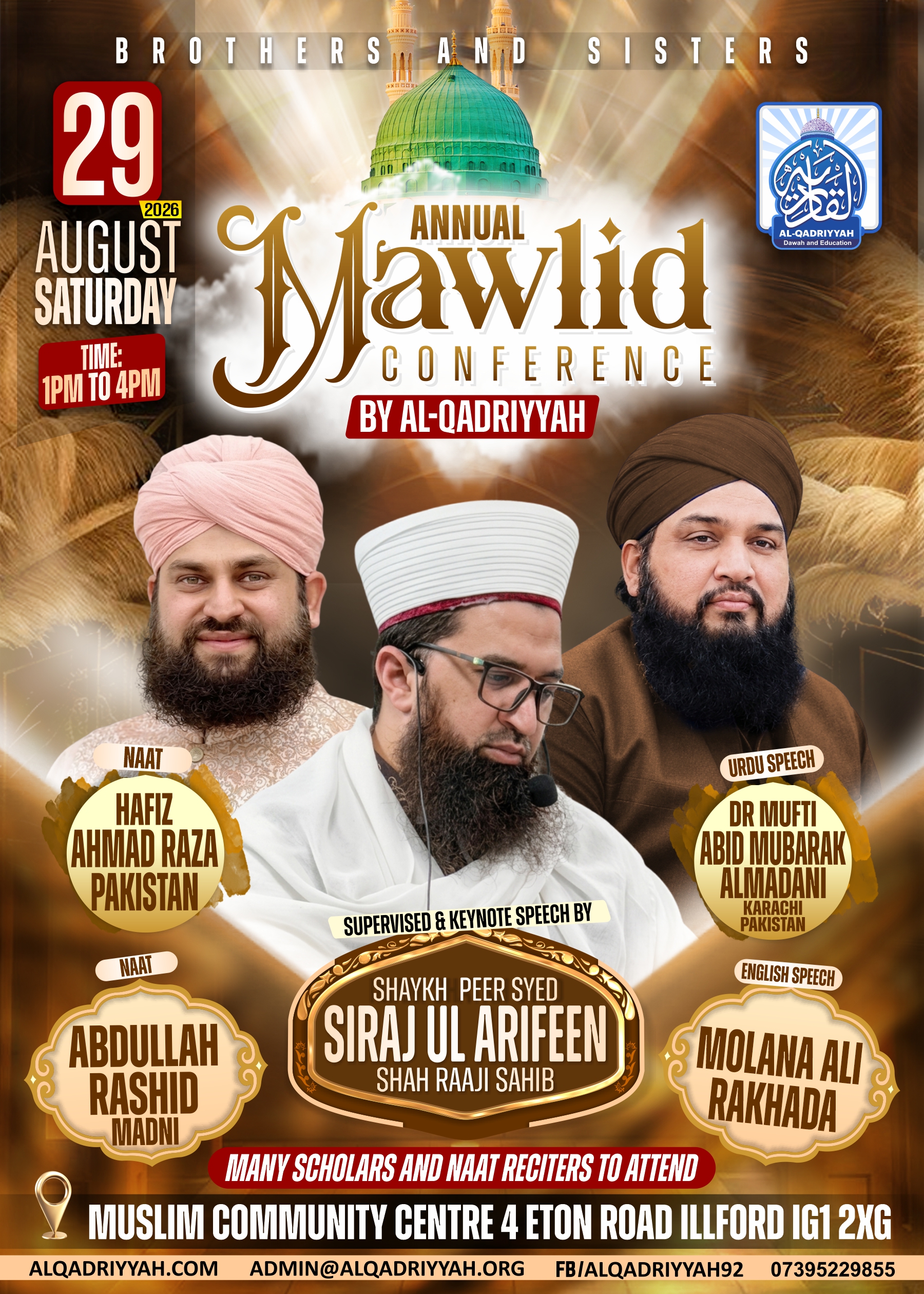
About the Conference
A Celebration of Love for the Prophet ﷺ
Al-Qadriyyah Islamic Education & Dawah Centre cordially invites you to the Annual Mawlid Conference 2026 — a blessed afternoon dedicated to the remembrance and love of the Best of Creation, our Master and Prophet, Sayyidunā Muḥammad ﷺ.
Featuring Naʿt Sharīf by distinguished reciters from Pakistan, scholarly addresses in English and Urdu, and a closing Duʾā. All Brothers and Sisters are warmly welcome.
After the Gathering
The Keynote — In Summary
A summary of this year’s keynote address — one reflection on our beloved Prophet ﷺ, unfolding in two parts. May Allah allow us not only to remember it, but to live it.
Raḥmatan lil-ʿĀlamīn
“And We have not sent you except as a mercy to all the worlds.” (Qur’an 21:107)
The first part opened with a single verse and drew out its full weight: mercy was not one of the Prophet’s ﷺ many beautiful traits — it was the very substance of his mission. Allah did not call him a warner, a teacher, or a lawgiver, though he was all three; He called him a mercy, and He did not limit that mercy to the believers, or to the Arabs, but to all the worlds.
- Mercy before the message. Long before revelation, even his opponents called him al-Amīn — the trustworthy. Khadijah رضي الله عنها testified that he kept the ties of kinship, carried the burdens of others, and helped the poor and the destitute.
- Mercy to the forgotten. Bilal رضي الله عنه, once enslaved and tortured, was raised to call the adhan above the Ka‘bah; the orphan was drawn near — “I and the one who cares for an orphan will be like these two in Paradise”; and Anas رضي الله عنه served him ten years and was never once scolded.
- Mercy to enemies. At Ta’if, bloodied and rejected, he prayed for the guidance of their descendants rather than their destruction. At the Conquest of Makkah, holding complete power over those who had driven him out, he chose amnesty: “Go — you are free.”
- Mercy to all creation. The hungry camel whose owner he corrected; the mother-bird whose distress he noticed; the man whose sins were forgiven for giving water to a thirsty dog. “Allah has prescribed excellence (iḥsan) in all things.”
- Mercy at home — and even in war. “The best of you are those best to their families.” And even in battle he forbade harming women, children, the elderly, or the trees and crops of the land.
- Mercy in the path itself. He came to lift burdens, not add them: “Make things easy and do not make them difficult; give glad tidings and do not drive people away.”
What does this mercy ask of us? That our love become character — that we each become someone “from whose tongue and hand people are safe” — and that we refuse to keep our mercy only for those who look, think, and pray as we do.
The Prophet ﷺ for Our Age
Youth, technology, and the search for identity.
The second part carried that same Prophet ﷺ into the world our young people actually live in — a world of endless screens, constant comparison, rising anxiety, and quiet loneliness. The seerah, it argued, is not a relic to admire from a distance but a living map for exactly this age; and the Prophet ﷺ speaks to each of our afflictions at their root: the heart.
- He trusted the young. ‘Ali, Mus‘ab ibn ‘Umayr, Usamah, and Mu‘adh رضي الله عنهم — youth entrusted with the very greatest responsibilities. The first generation of Islam was, overwhelmingly, a generation of the young.
- Guard your attention. “In the body is a piece of flesh; if it is sound, the whole body is sound — truly, it is the heart.” Our attention is the doorway to the heart, and distraction is the sickness of the age; the sunnah is a training in presence.
- Moderation over excess. “The din is ease.” True richness is the richness of the soul, and contentment is a quiet freedom from a world engineered to keep us restless and wanting more.
- The cure for anxiety and loneliness. Tawakkul — “tie your camel, then place your trust in Allah” — the supplications he taught for worry, and real, embodied community: the ummah as one body, a closeness no screen can replace.
- Guard the tongue — and the thumb. “Whoever believes in Allah and the Last Day, let him speak good or remain silent.” A careless word once travelled as far as a voice; now it circles the earth in seconds and lives forever.
- Seek truth amid the noise. In an age drowning in claims, he taught us to take our religion from those grounded in knowledge, and to verify before we believe or share: “If a corrupt person brings you news, verify it” (49:6).
- Choose your company. “A person is upon the religion of his close friend” — and today our feeds are our companions. The one perfect example has already been placed before us: uswatun ḥasanah, a beautiful pattern to follow.
- A rooted identity. Not the shifting sands of the feed, but our standing before Allah: heirs of the prophets, members of one ummah, in which there is “no superiority except by piety.”
The storm around our generation is real — but we are not without a guide. The same Prophet ﷺ who gave a lost and fractured people purpose, dignity, and belonging offers the very same to us today. The only question is whether we will take his hand.
Take it home — this week
- Restore mercy to one strained relationship.
- Let go of one grudge — forgive, for his sake.
- Show kindness to someone outside your circle.
- Keep your five prayers screen-free and present.
- Speak good or stay silent — online too.
- Curate your feed: drop one, follow one better.
Allāhumma salli ‘alā sayyidinā Muḥammad.
Al-Qadriyyah · Dawah and Education
Programme
Scholars & Naat Reciters
Many more scholars and Naʿat reciters to attend. Full programme to be confirmed.
Reserve Your Place
Tickets
Knowledge & Understanding
About the Mawlid — Common Questions Answered
The word Mawlid (also written Milad or Mawlud) comes from the Arabic root meaning birth. When Muslims say “Mawlid al-Nabī” they mean the celebration of the birth of our beloved Prophet, Sayyidunā Muḥammad ﷺ.
It is a time for Muslims to gather together, recite Naʿt (poetry in praise of the Prophet ﷺ), listen to his blessed life story, send Salāwāt upon him, and renew our love and connection to him. Far from being a mere birthday party, the Mawlid is a deeply spiritual occasion rooted in gratitude to Allāh سبحانه وتعالى for sending His greatest blessing to mankind.
Yes. The vast majority of Muslim scholars throughout history — including giants of Islamic scholarship such as Imām al-Sūyutī, Imām Ibn Ḥajar al-ʿAsqalānī, Imām al-Nawawī, and Imām Ibn Ḥajar al-Haytamī — have affirmed that celebrating the Mawlid is not only permissible but praiseworthy.
The Prophet ﷺ himself showed us that commemorating blessed days is part of our faith. When he was asked why he fasted on Mondays, he replied: “That is the day I was born and the day revelation first came to me.” (Muslim). This hadith is one of the key evidences scholars use to support the Mawlid, as it shows the Prophet ﷺ himself marked his own birthday as a day of worship and gratitude.
Reference: Ṣaḥīḥ Muslim, Book of Fasting; Imām al-Sūyutī, Ḥusn al-Maqṣid fī ʿAmal al-Mawlid
This is a common question and one that deserves a clear, calm answer. The concept of bid‘ah in Islam refers to introducing something into the religion itself that contradicts or has no basis in the Sharīʿah. Scholars have long distinguished between bid‘ah in acts of worship (which is forbidden) and bid‘ah ḥasanah — praiseworthy new practices that have a sound basis in Islamic principles.
Imām al-Shāfiʿiī himself said: “New matters are of two kinds: that which contradicts the Qurʾān, Sunnah, or consensus of scholars — that is bid‘ah ḏallālah (blameworthy). And that which is good and does not contradict any of these — that is bid‘ah ḥasanah (praiseworthy).”
Gathering to praise the Prophet ﷺ, recite from his Sīrah, and send Salāwāt — every one of these acts is individually encouraged in the Qurʾān and Sunnah. Bringing them together on this occasion is therefore praiseworthy, not blameworthy.
Reference: Imām al-Nawawī, Tahdhīb al-Asmāʾ wal-Lughāt; Imām Ibn Ḥajar al-ʿAsqalānī, Fatḥ al-Bārī
The spirit of the Mawlid — gathering to honour, praise, and remember the Prophet ﷺ — has roots going back to the earliest generations of Islam. The Companions رضي الله عنهم would regularly gather to recite poetry in his praise, as the great poet Ḥassān ibn Thābit رضي الله عنه did with the full blessing of the Prophet ﷺ himself.
The formalised Mawlid gatherings as we know them today became widespread from around the 6th Islamic century, notably championed by the pious ruler Sulṭān Muzaffar al-Dīn of Irbil, whose Mawlid celebrations were attended and praised by leading scholars of his age, including the great ḥadīth master Imām Ibn Diḥyah al-Kalbī.
Critically, no major scholar of that era declared these gatherings forbidden. The silence of disapproval and the active praise of scholars is itself significant evidence of their acceptance.
Allāh سبحانه وتعالى Himself, along with His Angels, sends blessings upon the Prophet ﷺ. In the Noble Qurʾān He commands the believers: “Indeed, Allāh and His Angels send blessings upon the Prophet. O you who believe, send blessings upon him and greet him with a worthy greeting.” (Sūrat al-Aḥzāb 33:56)
Every single Salāwāt we send returns to us tenfold in blessings from Allāh. The Prophet ﷺ said: “Whoever sends one blessing upon me, Allāh sends ten blessings upon him.” (Muslim). The Mawlid gathering is therefore an extraordinary opportunity to accumulate immense reward simply by doing what Allāh Himself has commanded.
Reference: Sūrat al-Aḥzāb 33:56; Ṣaḥīḥ Muslim
Attending a Mawlid gathering carries multiple spiritual benefits:
Renewing love for the Prophet ﷺ — The Prophet ﷺ said: “None of you truly believes until I am more beloved to him than his children, his parents, and all of mankind.” (Bukhārī & Muslim). The Mawlid rekindles this love in the heart.
Learning his Sīrah — Hearing about his birth, his character, and his life is itself an act of worship and a means of guidance.
Community and brotherhood — Gathering with fellow believers in the remembrance of Allāh and His Prophet ﷺ is one of the greatest acts a Muslim can perform. The Prophet ﷺ said that Allāhʼs mercy descends upon gatherings of dhikr.
Spiritual elevation — Scholars teach that sincerely loving and praising the Prophet ﷺ is a direct means of drawing closer to Allāh سبحانه وتعالى and to the Prophetʼs intercession on the Day of Judgement.
The Qiyām — standing when the birth of the Prophet ﷺ is mentioned or when Salāwāt is being recited — is a longstanding practice among Muslims globally. Scholars differ on whether it is obligatory, but the majority consider it a praiseworthy and permissible act of veneration and love.
It is an expression from the heart — a natural rising in honour of the one we love most after Allāh سبحانه وتعالى. Imām al-Sūyutī and many other scholars wrote in its favour, and it has been the practice of the overwhelming majority of Muslims throughout the world for centuries.
Those who do not stand should not be compelled, and those who stand should not be criticised. What matters is the sincerity of the love in the heart.
Make a sincere intention — Intend to attend for the love of Allāh and His Prophet ﷺ, and to increase in knowledge and love.
Recite Salāwāt throughout — Whether travelling to the venue or waiting for the programme to begin, fill that time with blessings upon the Prophet ﷺ.
Bring your family — Especially children. Exposing them to the love of the Prophet ﷺ from a young age plants a seed that will benefit them for life.
Make Duʾā — Gatherings of dhikr and praise are among the best times for duʾā to be accepted. Come with your needs and trust in Allāhʼs generosity.
Share the event — Inviting others earns you a share of their reward. Every person you bring adds to your own scale of good deeds.
Further Reading
Articles on Mawlid, Rabīʿ al-Awwal & Sīrah
Spread the Word
Share with family and friends and earn the reward of spreading love for the Prophet ﷺ.